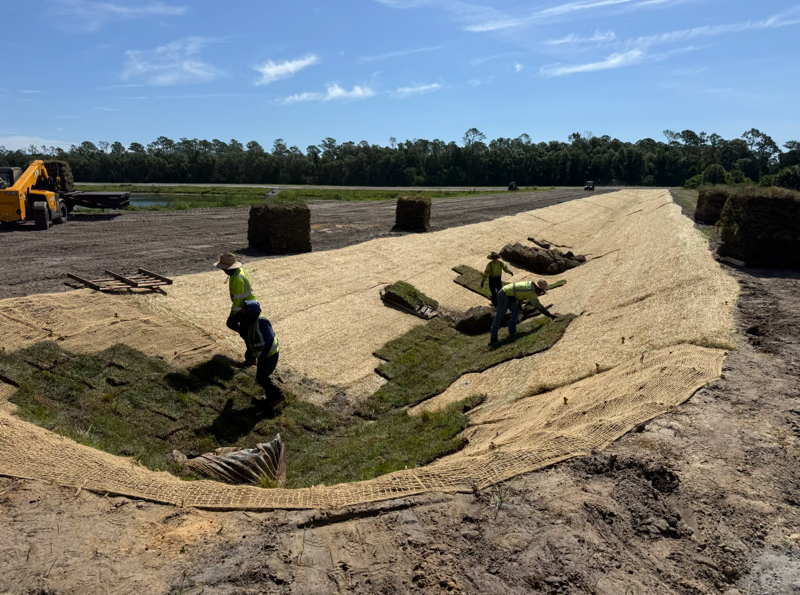

Stabilizing embankments, slopes, and swales is one of the toughest challenges in Florida sitework. Between sandy soils, steep grades, and sudden downpours, you need vegetation and reinforcement that can hold the line. That’s why contractors rely on sod, sometimes alongside pins and/or erosion control blankets or matting to create immediate protection and long-term stability.
Unfortunately, even the best materials have limits – especially when heavy rain, flowing water, or heavy water-truck (or other irrigation) spray hits before everything is fully established.
Sod remains one of the strongest tools for stabilizing any type of slope because it provides instant vegetation and will quickly establish a root system. Instead of waiting weeks for seed to germinate, sod immediately covers bare soil and begins anchoring into the ground.
Key benefits include:
- Immediate erosion protection with no exposed soil
- Fast root establishment that knits into the slope
- Surface stabilization that reduces soil movement
- Improved water flow control in swales and drainage paths
For swales, pond banks, landfill slopes, roadway embankments, etc, sod is often the only vegetation that can handle the job.
Erosion control blankets and matting add another layer of protection, especially on steep slopes or areas with loose, sandy, or disturbed soils. They help hold soil in place, reduce surface erosion, and support vegetation establishment.
These are especially useful when:
- Slopes are too steep for sod alone
- Soil is loose or recently disturbed
- Seeded areas need reinforcement
- Water flow is moderate but not high-velocity
- Long-term Protect is required
When paired with sod or seed, blankets and matting create a reinforced system that resists erosion while vegetation takes root.
Whether you’re installing sod or securing erosion control blankets, pins and staples are essential. They keep materials in place during the early establishment period.
But here’s the reality: Pins assist, but they don’t override basic physics.
Even with proper pinning, materials can still shift or wash out when exposed to heavy rainfall, high-velocity flowing water, water truck spray hitting too hard, improper grading or compaction, standing water or channelized flow. Pins are a support tool, not a guarantee.
Florida storms are no joke. When a slope takes a direct hit from a downpour or a water truck nozzle, even pinned sod or matting can move. Water follows gravity, and if the flow is strong enough, it can lift, peel, or shift materials before roots have time to fully establish.
That’s why long-term stabilization requires a system, not a single product.
The strongest approach includes: proper grading and compaction, sod or seed, erosion control blankets or matting where needed, strategic pinning, gentle, consistent watering, and avoiding high-pressure spray on slopes.
When all these elements work together you get a slope that can stand up to Florida’s unpredictable weather.
Sod, erosion control blankets, and matting are powerful tools for stabilizing embankments, slopes, and swales. They provide immediate protection and long-term strength; however, they’re not invincible. Heavy rain, flowing water, and improper watering can still cause movement before everything is fully established. With proper installation and realistic expectations, these materials create a reliable, durable stabilization system.